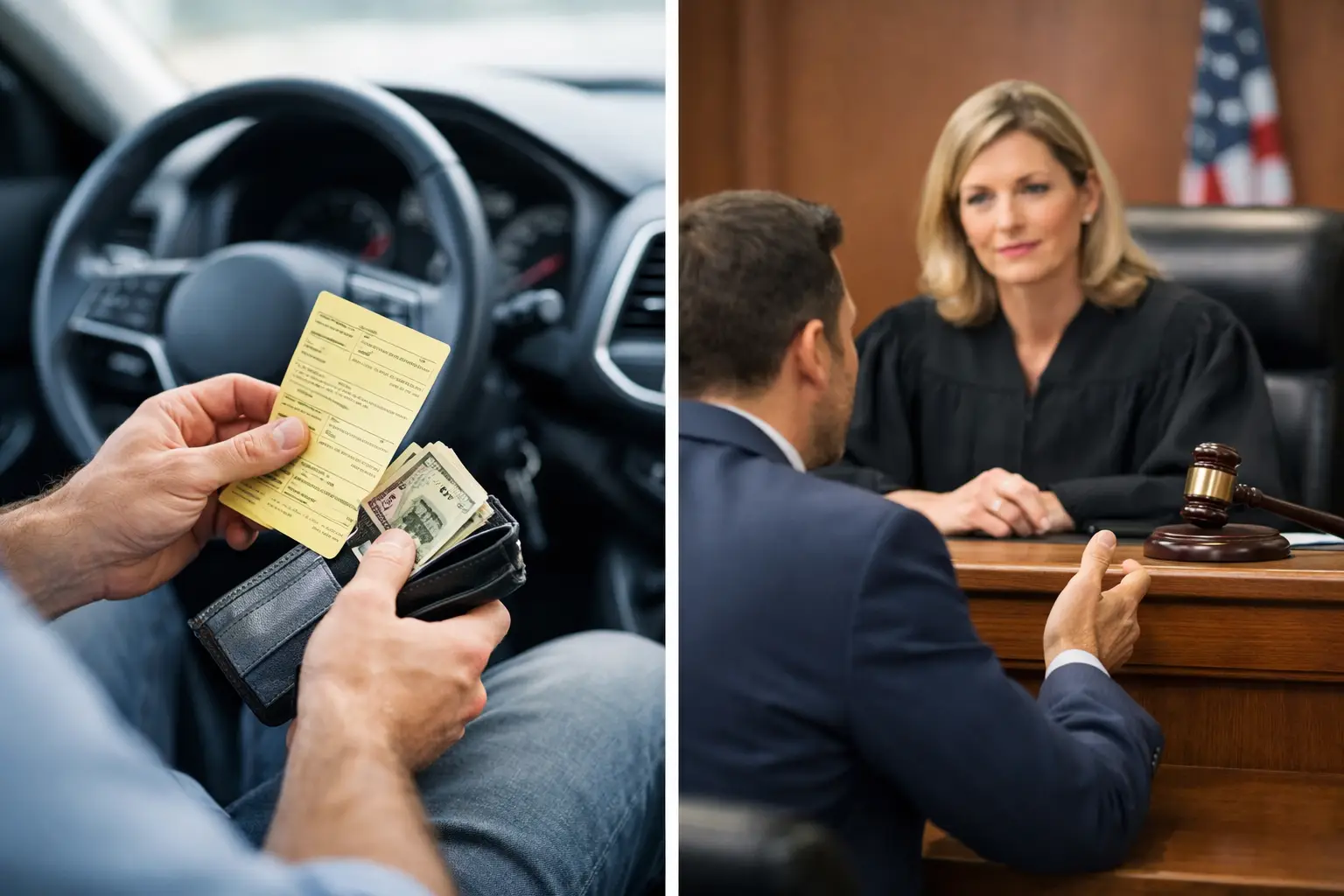
A traffic ticket can feel like a minor inconvenience until you see the fine, the point consequences, and the risk to your insurance rate. When you are weighing paying a ticket versus contesting a citation, the fastest choice is not always the least expensive one. For many South Florida drivers, simply paying can create consequences that last long after the original fine is forgotten.
The right move depends on the type of citation, your driving record, your license status, and whether your job depends on driving. Before you pay online, understand what that payment may mean.
What Paying a Traffic Ticket Usually Means
For many Florida civil traffic citations, paying the fine is treated as an admission of the violation. You may close the ticket quickly, but you may also accept the consequences that come with it.
Those consequences can include points on your license, a higher insurance premium, and a record of the violation. A few points may not seem urgent, especially if you have never had a ticket before. But points add up. Accumulating too many points within a set period can lead to a license suspension.
Paying may make sense in limited situations. If the citation has no point consequence, your record is otherwise clean, and you are comfortable with the full cost, a direct payment may be the simplest option. But convenience at checkout is not the same as protection for your driving record.
It is also worth separating the court fine from the total financial impact. The amount printed on the citation is only the immediate cost. Insurance increases, employer concerns, CDL implications, and future license problems can make a quick payment much more expensive over time.
Paying a Ticket Versus Contesting a Citation: The Real Difference
Contesting a citation means challenging the allegation or asking for a legal resolution that avoids the usual consequences of simply paying. It does not always mean a dramatic trial or an argument in front of a judge. In many cases, a traffic attorney can handle the filing, review the evidence, communicate with the court, and appear on your behalf.
The goal is not to make an unrealistic promise that every ticket disappears. The goal is to protect what matters: your license, your record, your time, and your money.
A lawyer may identify issues with the citation, officer evidence, radar or pacing procedures, accident reports, or the legal basis for the charge. In other situations, the strongest result may come through negotiation or another court-approved resolution. Every ticket has its own facts, which is why paying before reviewing your options can be a costly mistake.
For drivers who want minimal involvement, contesting can be the more practical choice. Rather than taking time off work, figuring out court procedures, or sitting through traffic school, you can put the case in the hands of a professional who handles these citations every day.
Why Points Matter More Than Most Drivers Expect
Florida points are not just a number on a driving record. They can affect your ability to keep driving legally.
A driver who receives 12 points within 12 months may face a 30-day suspension. Higher point totals over longer periods can lead to longer suspensions. One speeding ticket may not trigger a suspension by itself, but it can put you much closer to a problem if another violation occurs.
Points can also matter to insurance companies. Insurers set their own rates and underwriting standards, but a moving violation can be a reason for higher premiums. The increase may continue at renewal, meaning the financial effect can outlast the ticket by years.
For a working driver, the stakes can be even higher. A clean record can affect employment opportunities, company vehicle eligibility, and professional credibility. If you drive for deliveries, sales, home services, rideshare work, or any job requiring a dependable vehicle, protecting your record is a business decision as much as a personal one.
CDL Drivers Need a Different Level of Caution
Commercial drivers should never assume a ticket in a personal vehicle is harmless. Certain violations can affect a CDL holder’s record and employment, even when the ticket was received off duty. The rules and consequences can be more complicated than they are for a standard Florida license.
A CDL driver should review the citation immediately and get legal guidance before choosing a payment option. A quick online payment may create an employment issue that costs far more than the fine.
When Contesting a Citation Is Often Worth It
Contesting is especially worth considering when the ticket involves speeding, careless driving, reckless driving, red light allegations, a crash, a suspended license issue, or a violation that could put points on your record. These are not tickets to handle casually.
It is also a smart move if you have prior violations, already have points, recently completed traffic school, or cannot afford to miss work for a court date. The more your license affects your income and daily responsibilities, the more value there is in protecting it.
There are cases where a driver believes the officer made a mistake. Maybe the vehicle description is wrong, the speed was not accurately measured, the traffic signal situation was unclear, or the circumstances of an alleged careless driving violation are disputed. Those facts matter, but you do not need to know the legal arguments yourself before seeking help.
The deadline matters too. Florida citations come with response deadlines. Waiting can limit your options or lead to additional problems, including a suspended license for failure to comply. Handle the ticket promptly, but do not confuse acting promptly with paying immediately.
Traffic School Is Not Always the Best Answer
Many drivers consider traffic school because they have heard it can avoid points on an eligible ticket. That option may be useful for some people, but it has limits.
Traffic school takes time. You may have to register, complete the course by a deadline, provide proof of completion, and still pay the fine or related costs. It may also not be available or desirable for every type of violation or every driver’s situation.
Most importantly, traffic school does not contest the citation. It is a way of resolving certain cases, not a challenge to what happened. If your priority is avoiding the inconvenience of a course and keeping the process off your plate, legal representation may offer a better fit.
A Simple Way to Make the Decision
Start by reading the citation closely. Check the violation listed, the county, the deadline, the fine, and whether you already have points or prior tickets. Do not rely on a guess about what the charge means.
Next, think beyond today’s payment amount. Ask whether points could affect your insurance, your job, your CDL, or your ability to keep driving. If the answer may be yes, get the ticket reviewed before you make an admission by paying it.
Finally, choose the level of effort you are willing to take on. You can pay and accept the outcome. You can attempt to navigate the court process alone. Or you can have a traffic lawyer handle the paperwork and court appearance for you.
South Florida Ticket Lawyer is built for drivers who want that third option. For eligible traffic matters, clients submit the ticket, pay a $99 flat fee, and the firm handles the case with a focus on no points and no traffic school. No guessing about forms. No unnecessary time in court. No hidden-fee surprise after you have already committed.
Do Not Let a Small Ticket Become a Bigger Problem
A citation does not have to take over your week, but it does deserve a deliberate response. Paying is quick. Contesting can be protective. The better choice comes down to what is at risk on your record, not just what appears due on the ticket.
Before you press “pay,” give yourself the chance to protect the license you rely on every day.